

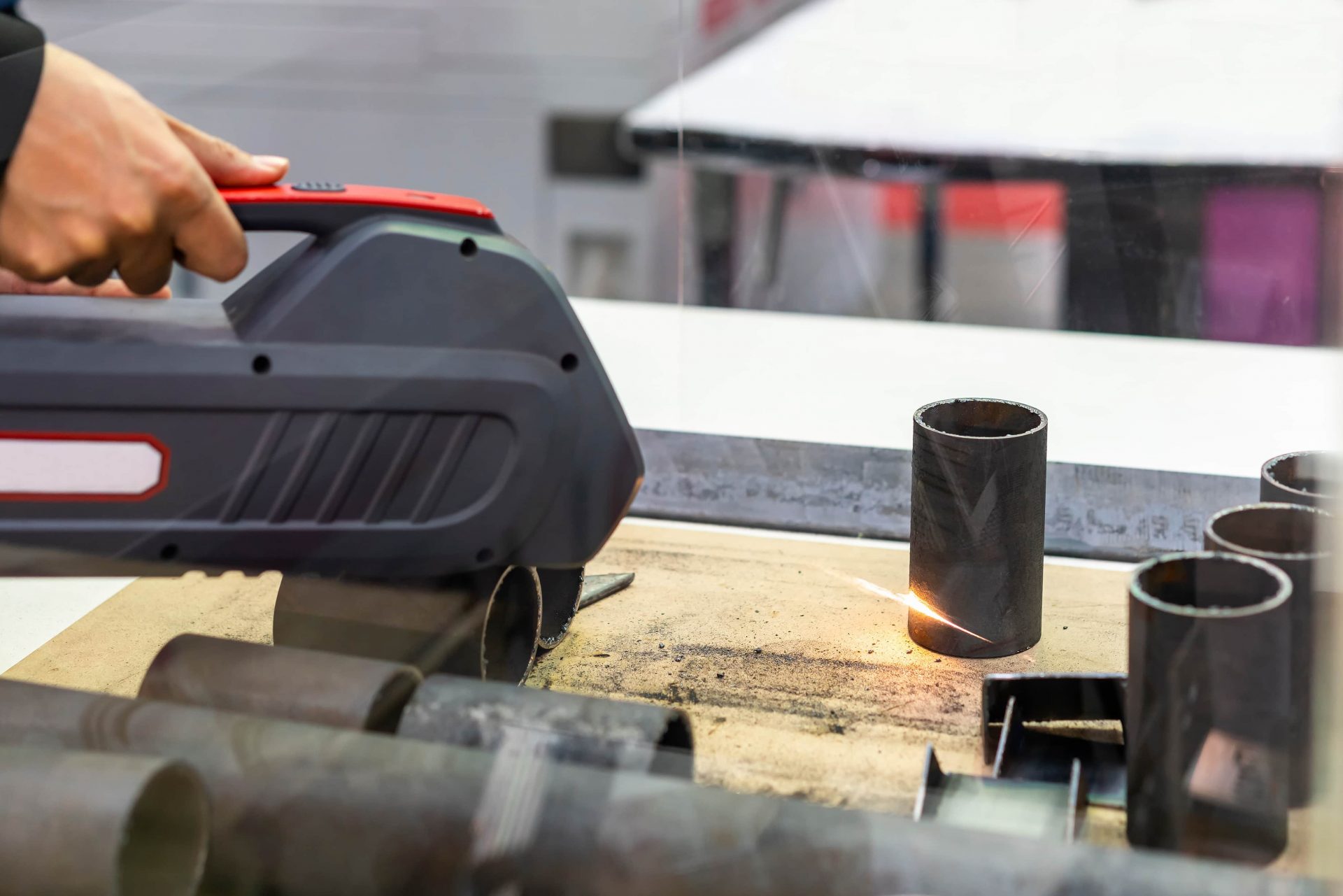
The word laser is short for light amplification by stimulated emission of radiation. The first working laser was built in 1960. Since then the technology has moved into cutting, welding, measurement and communications, and in the last decade into surface preparation: removing rust, paint and coatings from steel by laser ablation.
Perfect Remediation runs laser cleaning alongside abrasive blasting and mechanical preparation on industrial, infrastructure and heritage assets. This article sets out how the methods compare and where the laser earns its place.
The traditional methods
- Chemical stripping. Strippers are easy to source and can be applied to a small area. They run into crevices and can be hosed off. Against that, the vapours are harsh, the run off has to be collected and treated as contaminated, they stain concrete, and they struggle with multiple or heavy coatings.
- Abrasive blasting. Blasting removes coating and cuts a fresh anchor profile in one pass, which is why most coating specifications on structural steel are written around it. The media goes everywhere, so containment has to be built and the spent media recovered. On lead paint the spent media becomes classified waste by the tonne. Media also lodges in crevices and it does not deal well with grease and oil.
- Mechanical preparation. Grinders, wire wheels and needle guns are cheap to run and simple to deploy. They are slow over area, generate dust that needs capture, and cannot reach into tight corners and behind services.
What the laser changes
A fibre laser puts concentrated energy into the surface. The coating or rust absorbs it and vaporises, and the fume is captured by extraction at the head. The parent steel absorbs far less and is left in place.
- There are no consumables. No blast media, no stripper, no grinding discs.
- There is no silica or media dust, and no water or chemical run off.
- The waste is the coating itself, held in the filtration, rather than tonnes of contaminated media. On lead paint that is usually where the saving is.
- Because there is nothing to contain or recover, the plant can work inside an operating facility, on a bridge or on a heritage facade without a blast enclosure.
- The power is adjustable, so the same unit can be turned down for heritage stone and thin sections and turned up for heavy rust and thick coating systems.
Where it does not suit
- The laser does not cut an anchor profile. Where the coating specification calls for one, the steel has to be blasted.
- On large open areas of structural steel, blasting is faster and cheaper per square metre.
- It is a Class 4 laser. Every job needs a controlled zone, screening, correct eyewear and a trained operator, and reflective surfaces need managing.
Where that leaves it
Laser cleaning is a precision method for the parts of a job that blasting cannot reach or the site cannot tolerate: lead paint on structural steel inside a live plant, coating removal before recoating where containment would cost more than the work, graffiti on government and infrastructure assets, and heritage stone and masonry cleaned to the heritage architect's specification. Used for those, it extends the life of the asset without the cost of shutting it down.
Our laser rust, paint and coating removal page covers the plant we run and who we work for, and our laser cleaning or abrasive blasting article goes into the comparison in more depth.
Talk it through
We do this work for industrial asset owners and their facility managers, infrastructure owners, principal contractors, asset managers and heritage architects, to the engineer's or heritage architect's specification. We do not take on homeowner, house, cottage, fireplace, strata, balcony, apartment or single dwelling work, or small domestic jobs. Call Perfect Remediation on 02 7912 3054 with the coating specification and photos of the asset.
 Perfect Remediation acknowledges the Aboriginal and Torres Strait Islander people as Traditional Custodians of the country on which we live and work. We pay our respects to the Traditional Custodians and Elders past, present and future, and honour their connection to the land and ongoing contribution to society.